Territory & Communities
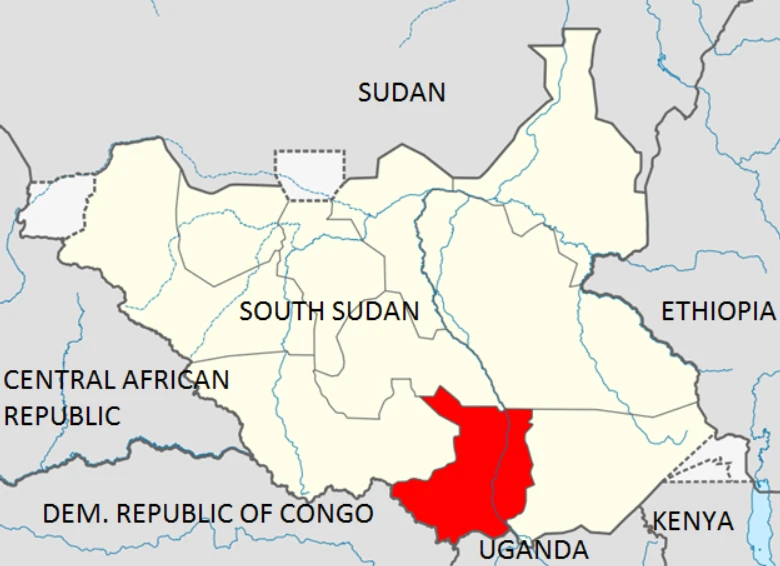
The Karo People occupy a large part of the present day Central Equatoria State in the Republic of South Sudan. The Karo People comprise of six common linguistic groups or segments: Bari, Kakuwa, Kuku, Nyepo, Nyangwara and Pöjulu. However, some small communities that share the same geographical territory with the named groups, and have coexisted with them for centuries, also speak the Karo language, despite having their own languages. These minority groups are (in alphabetical order): Kelikö/Kölikö, Lokoya, Lulubo, and sections of Makaraka, Mundu and Lugbara.
Commonly known as 'tribes' these segments of the Karo people are distinguished from each other by their names and dialects of the Karo language. KALDI prefers to call them 'Communities' for the simple reason that they share a lot in common, especially aspects such as common words, culture, folklore, baby naming, history, and of course territory.
The territory which the Karo People inhabit spans from the Sudd region of the Savannah marshlands in the north to the South Sudan-Uganda border at Kaya Town to the south, and from the eastern bank of the River Nile to the Democratic Republic of Congo-South Sudan border to the west. To be more precise, the territory occupied by the Karo People covers the west-east longitudes 29.8 to 31.8 degrees and the south-north latitudes 3.5 to 6.25 degrees. The total area occupied by the Karo people is approximately 22,000 km².
Origins & Culture
According to socio-anthropologists, the Karo people are part of the Sudanic ethnic groups, of the Nilo-Hamite cluster. This means culturally the Karo people share a lot in common with the rest of the Nilo-Hamites who mainly inhabit the Eastern Equatoria State, namely; Boya, Didinga, Lang'o, Lokoya, Lopit, Otuho, Toposa, and related groups in northern Uganda and northern Kenya. These groups share common cultural heritage, words, expressions and idioms.
The Karo people number between three to four million by official population estimates. Believed to have moved westwards from their original habitat in southern Ethiopia, centuries ago, the Karo people share common names such as Juan, Kaku, Keji, Kiden, Pita, Poni, for females, and Kenyi, Lado/Lodu, Laku/Loku, Mogga, Mori, Pitya, Wani, Yuggu, for males. One very common characteristic of the Karo People is traditional dance and folklore. The Karo people are largely agrarian (peasants) with exception of the Nyepo sub-linguistic group, which is agro-pastoralist. Subsistence farming, hunting, fishing and artisanry, commonly characterise the livelihood and economic activity of the Karo people.
Traditional Dance & Folklore
A defining cultural characteristic shared across all Karo communities.
Agrarian Livelihood
Subsistence farming, hunting, fishing and artisanry are core to Karo life.
Shared Naming Traditions
Common names like Wani, Lado, Kiden and Poni span all six communities.
Ethiopian Origins
Believed to have migrated westwards from southern Ethiopia centuries ago.
Land & Geography
Geographically, the land occupied by the Karo People is part of the Greenbelt and Iron Stone Plateaux agroecological zones. The land features are mainly hills, mountains, rivers, valleys and dense forest belts. The rural Karo People have subsisted by cultivating tropical crops such as sorghum, millet, cassava, potato, legumes and oil seeds. Hunting and fishing combine as a traditional preoccupation and source of food of these people.
Traditional Crops
At a Glance
Location
Central Equatoria State, South Sudan
Territory
~22,000 km²
Population
3–4 million
Ethnic Group
Nilo-Hamite, Sudanic
Livelihood
Agrarian & Agro-pastoralist
Landscape
Greenbelt & Iron Stone Plateaux
Six Communities
Learn More
Discover KALDI's work in preserving and developing the Karo Language for future generations.
About KALDI